

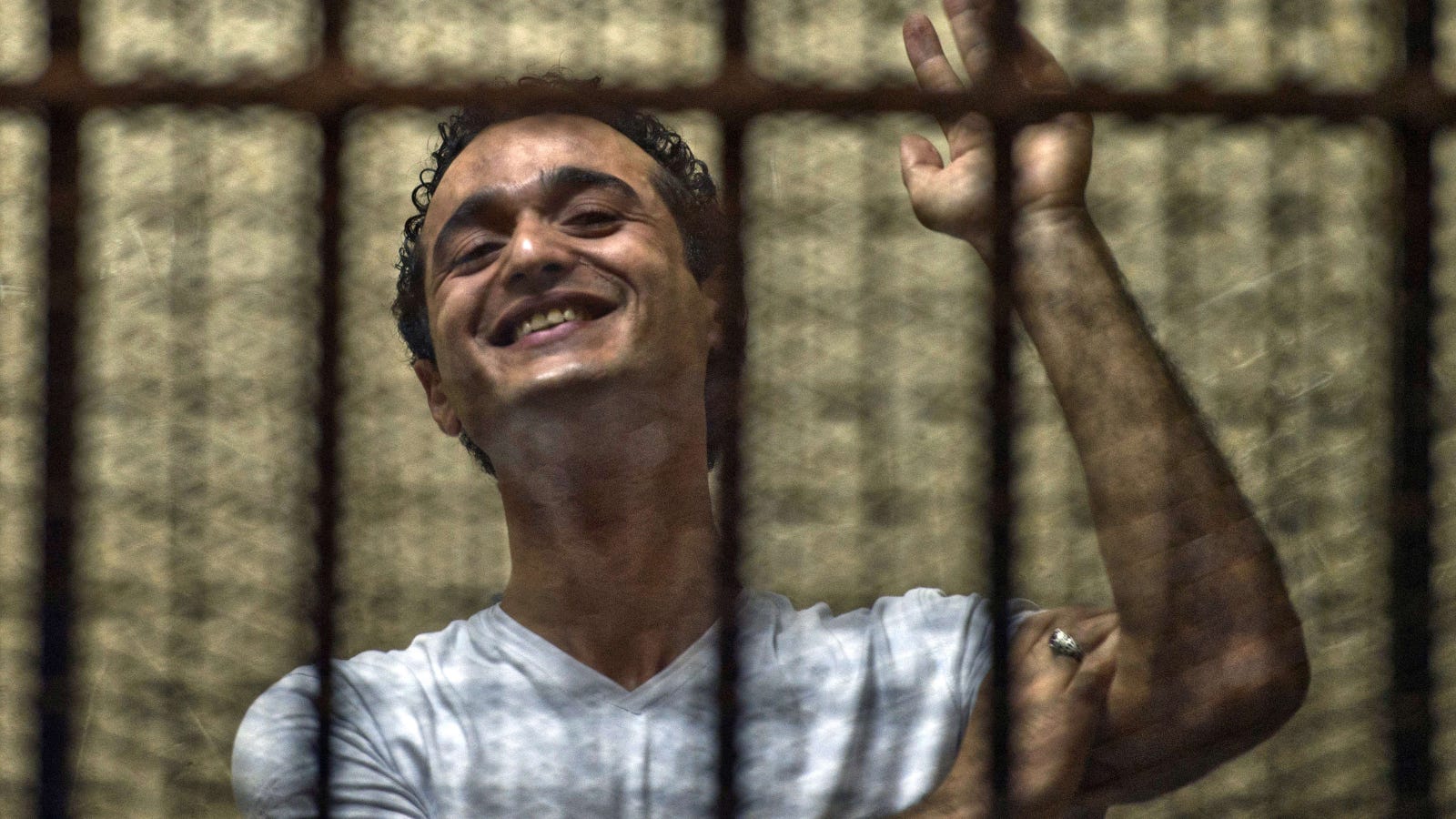
Ahmed Douma, a prominent Egyptian poet, writer, and activist, was rearrested on April 6, 2026, at the Supreme State Security Prosecution headquarters following a six-hour interrogation and held in pre-trial detention for nearly two months.
On June 3, he was sentenced to one year in prison on spurious charges, including “spreading false news,” stemming from a Facebook post criticizing the 24-hour lighting in Egypt’s prison cells and an article titled A Prison Within the State and a State Within the Prison. The charge of “spreading false news” is regularly used against Egyptian activists, journalists, writers, and everyday social media users.
Douma’s trial concluded after just two sessions and was marked by serious fair trial violations, including the court’s refusal to hear defense witnesses and experts or inspect detention facilities to verify his claim that 24-hour cell lighting causes sleep deprivation, which the prosecutor deemed ‘fake news’.
In the article, Douma argues that imprisonment has become a central tool of control for governments across the region and beyond, and warns of its long-term consequences for society.
“Analysts and rulers alike are mistaken when they interpret the silence of the streets in Cairo, Tunis, or the West Bank as forgetfulness, acceptance of reality, or preoccupation with the crisis of the moment. In political philosophy, silence born of fear is a form of ‘conscious waiting,’ not surrender. This is what I believe and advocate.
As for authorities that take pride in their ability to silence voices, they succeed only in transferring the conflict from the public squares into people’s hearts and minds, overlooking the fact that no square ever erupts without first being preceded by a mobilization of anger and grievance within people themselves.”
— Ahme Douma wrote in the article that resulted in his arrest.
Douma spent nearly 10 years in prison for participating in Egypt’s 2011 pro-democracy revolution. During his imprisonment, he was subjected to torture, denied medical care, and held in solitary confinement for four years.
He was released in 2023 on a presidential pardon; however, Egyptian authorities continued to target him through arbitrary summons, interrogations, a travel ban, and denial of official documents. He also faced threats and physical attacks to silence him from criticizing the government.
“The weaponization of the criminal justice system against Ahmed Douma and other activists lays bare President Abdel Fattah al-Sisi’s government’s relentless campaign to crush peaceful dissent and restrict civic space,” Mahmoud Shalaby, Amnesty International’s Regional Researcher, said in a statement.
Egyptian authorities have systematically dismantled space for dissent, punishing those who speak out while severely restricting the rights to freedom of expression, peaceful assembly, and association. Journalists, activists, human rights defenders, and bloggers have been arbitrarily detained—often for months or years without trial—and prosecuted on charges tied to their reporting, advocacy, or criticism of the government.
Since the 2013 military takeover, Egyptian dictator Abdel Fattah el-Sisi’s rule has been marked by severe repression and widespread human rights abuses. Egypt is estimated to hold over 60,000 political prisoners, many of whom are confined to filthy cells, tortured routinely, and denied life-saving medication.
Thousands face enforced disappearances, prolonged detention without trial, mass death sentences, and prosecution in military courts. To manage this influx, the Egyptian government has built dozens of new prisons and jails in the past decade.