

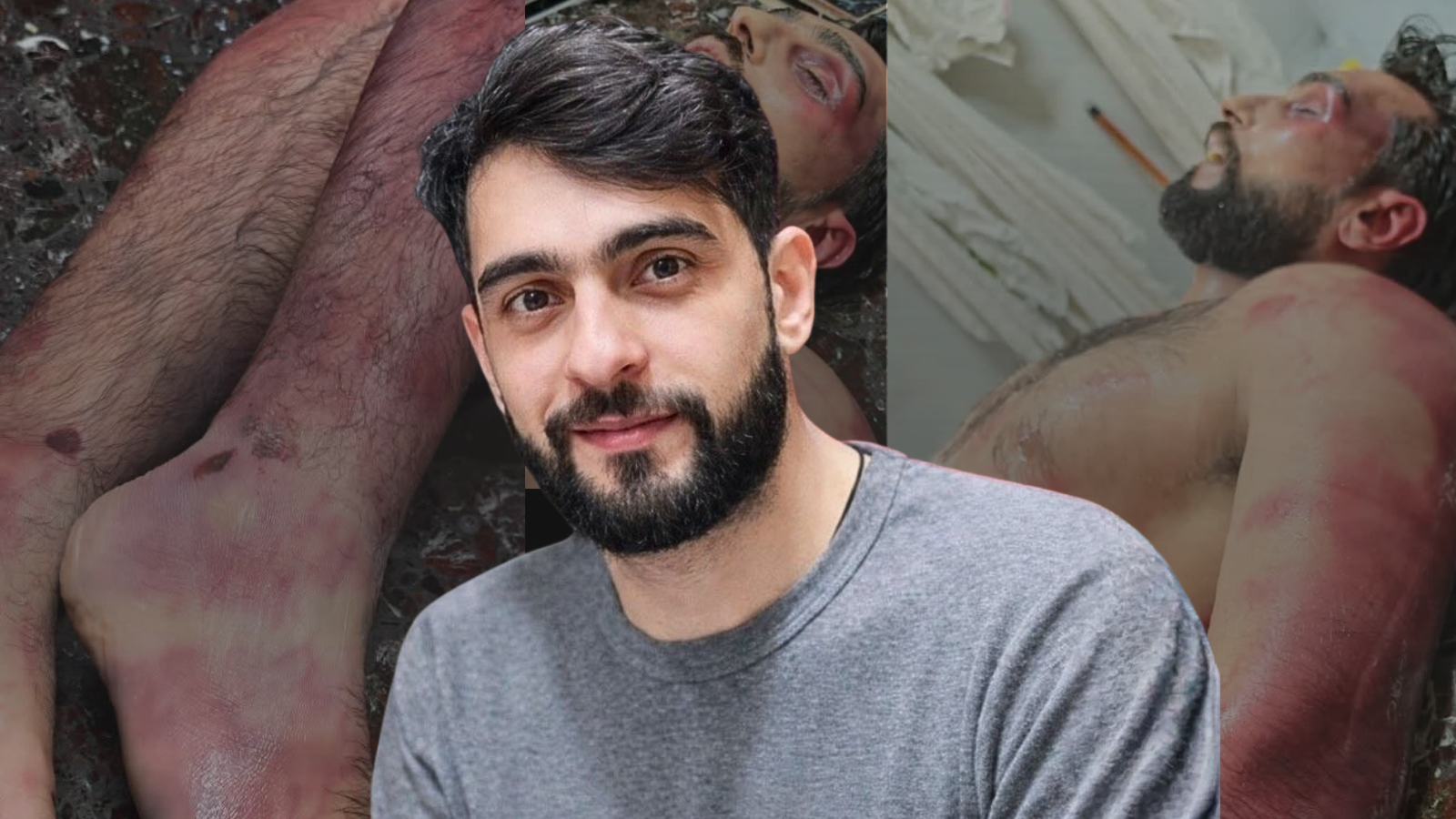
Warning: The following images contain graphic content.
Mohamed Al-Mosawi, 32, and six of his friends were arrested at a checkpoint on March 19 while out for a pre-dawn Ramadan meal and forcibly disappeared, with no access to their families or a lawyer.
On March 27, Al-Mosawi’s family received a call to collect his body from the Bahrain Defense Force Hospital. Authorities claimed Al-Mosawi had been arrested on alleged charges of “espionage.” The fate of the others arrested with him remains unknown.
Disturbing videos and photos showed clear signs of torture across his face and body.
“Sayed Mohammed AlMousawi, who was tortured to death by the Bahrain regime, was 32 years old. He was 18 when he was arrested the first time and 30 when he was finally released with a pardon 2 years ago. Read that again. And then think about that those arrested with him are still subjected to enforced disappearance,” Maryam Al-Khawaja, a Bahraini-Danish human rights defender and daughter of prominent imprisoned activist Abdulhadi Al-Khawaja, wrote on X.


Al-Mosawi, a Shia activist, was first arrested at age 18, like hundreds jailed during the 2011 pro-democracy protests, and spent more than a decade as a political prisoner in the notorious Jau Prison. He was released in 2024 as part of a royal pardon that freed more than 1,500 prisoners. Now, two years later, he was rearrested and tortured to death.


Ebtisam Al-Saegh, a prominent activist who was previously tortured and sexually assaulted by members of Bahrain’s National Security Agency while in custody, told MEE that she “feels pain and helplessness” after Al-Mosawi’s death.
“The state of his body reminds me of many men whose bodies emerged from security custody in the same condition.”
Human Rights Watch said on March 19 that since the start of the war, Bahraini authorities have arrested dozens of people for peacefully demonstrating or posting on social media, in some cases seeking the death penalty.
HRW reported that detainees have been denied the right to contact their families or lawyers for several days.
Bahrain has increasingly tightened restrictions on civic space, deepening a longstanding crackdown on free expression. Authorities continue to arbitrarily imprison political leaders and activists and routinely deny them medical care, including for conditions caused by torture.
“This death cannot be viewed as an isolated incident. Rather, it is part of a broader, well-documented pattern of abuse that includes torture, enforced disappearance, arbitrary detention, denial of medical care, and systematic targeting of individuals for exercising their fundamental rights,” the Bahrain Center for Human Rights (BCHR) said in a statement.
Hundreds attended Al-Mosawi’s funeral on Friday, chanting anti-government slogans, including “Down with Hamad,” referring to the king.
Anti-government protests in Bahrain, including mass uprisings in the early 1990s and in 2011, have consistently been violently suppressed by authorities. Activists and dissidents face arbitrary arrests and sham trials.
“We feel fear and terror as citizens, and this is why today, especially Shia citizens, feel unsafe. At any time, in any place, at a checkpoint, you can be arrested. Your home can be raided. You can be detained for any reason, disappear completely, and then suddenly your family finds your lifeless body,” one attendee at Al-Mosawi’s funeral told MEE.


Rights groups say recent arrests in connection with the war have disproportionately targeted Shi’a communities, who make up the majority of Bahrain’s population and have long faced systemic discrimination and repression.
The 2011 pro-democracy uprising in Bahrain was led largely by Shi’a citizens against the Sunni ruling Al Khalifa royal family. With the backing of Saudi Arabia and other Gulf states, authorities violently suppressed the protests and cracked down on dissent.
“There is widespread resentment, fear and terror in Bahrain, especially among Shias, who now feel targeted. These arbitrary measures are all directed at one sect only,” Naji Fateel, a Bahraini human rights defender who spent years behind bars and whose son was arrested this month, told AFP that pro-government Bahrainis are targeting Shi’a activists online, warning that a sectarian backlash is already underway.
Bahrain hosts the headquarters of the U.S. Navy’s Fifth Fleet, where more than 9,000 Department of Defense personnel are stationed.
The presence of American bases in Bahrain has been a point of contention for decades, with many Bahrainis viewing them as inviting conflict into the country. In recent weeks, the bases have drawn renewed criticism and protests.
Some believe the release of Al-Mosawi’s body, bearing visible signs of abuse, was a deliberate attempt by the government to instill fear and suppress dissent.
“The message is clear: the government warns and cautions, through the martyr [Al-Mosawi], against protesting, showing solidarity, or speaking up. The government wants a silent people who see nothing, hear nothing, and say nothing,” one attendee at Al-Mosawi’s funeral told MEE.