

In the words of Palestinian author Ghassan Kanafi: “They steal your bread, then give you a crumb of it. Then they demand your gratitude.” In Gaza, this sentiment is policy.
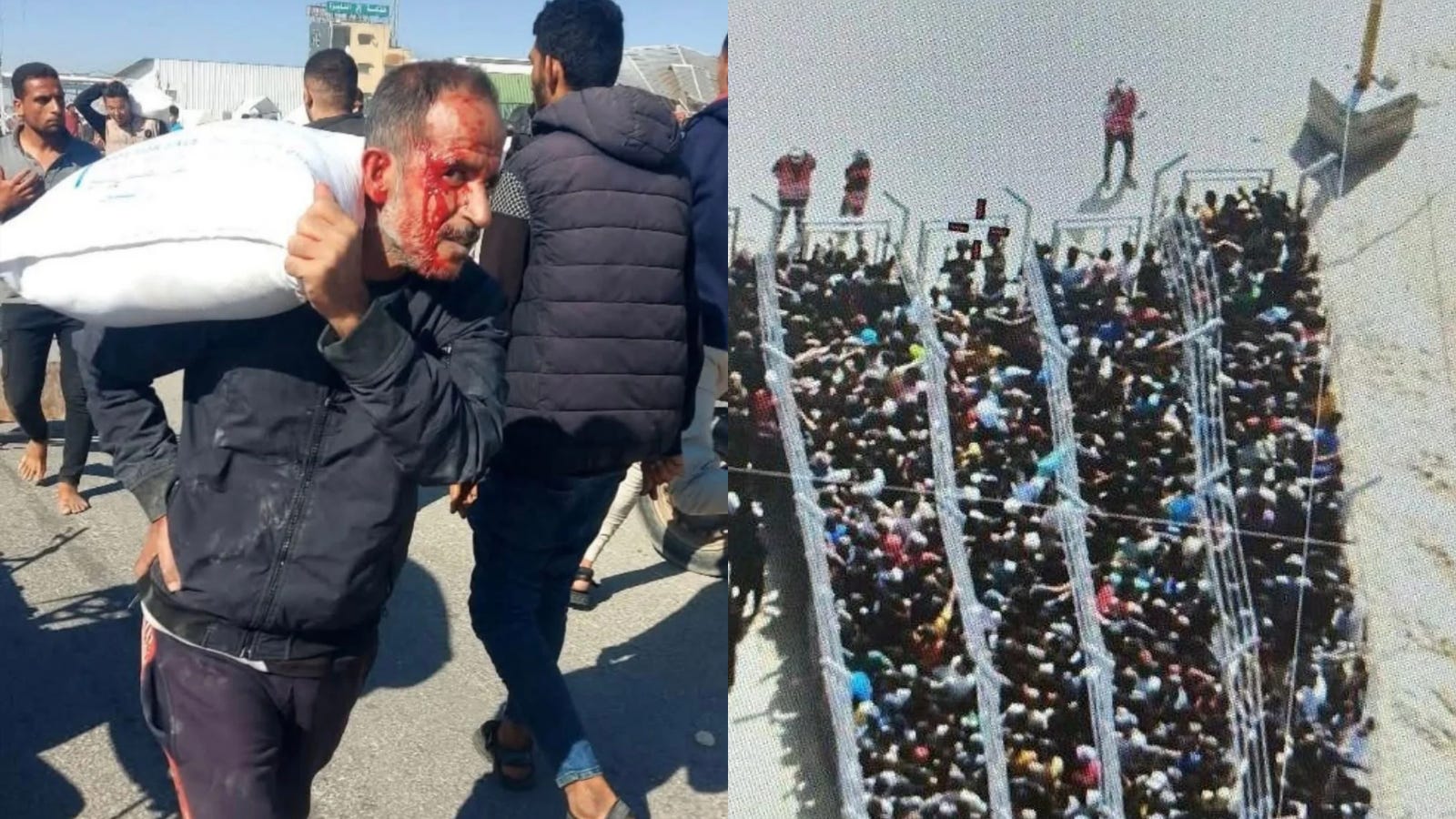
When thousands of Palestinians were lined up like cattle to retrieve aid under the watchful eye of Israeli snipers, the world saw the violent collapse of the illusion that humanitarian aid serves humanity rather than the empire. The US-Israeli Gaza Humanitarian Foundation distribution sites quickly became a theater of humiliation—a system designed not to feed the starved, but to manage their deaths.
Today, humanitarian aid in Gaza has become a ritual of humiliation—a performance of power disguised as compassion. A death trap masquerading as mercy.
On March 19, the Israeli Prime Minister’s Office said it would allow a “basic amount of food” into Gaza for “practical and diplomatic reasons”—not to relieve suffering, but to prevent famine from interfering with the ground invasion. Aid not to save lives, but aid to save optics. Netanyahu himself admitted: “Our best friends… senators I know as strong supporters of Israel—have warned they cannot support us if images of mass starvation emerge.”
So food was permitted—not as nourishment, but as camouflage.
The violence of hunger is not only physical; it is also psychological. Mothers wait for hours in flour lines that may never move. Children cry not only from the emptiness of their stomachs but also from watching their parents’ helplessness. What is stolen is not just food—it’s agency.
Between May 19 and 23, only 100 aid trucks entered Gaza after three months of blockade. During the ceasefire, 500–600 trucks were needed daily. At least 300 people—mostly children—have already died from hunger. Out of the 91 attempts the UN made to deliver aid to the besieged north Gaza between October 6 and November 25, 2024, 82 were denied and nine impeded.
Nearly 71,000 children under the age of 5 in Gaza are at risk of acute malnourishment, with at least 57 children already dead due to hunger since the blockade began in March. And still, this is called “complex.” The UN special rapporteur on the right to food said Israel’s deliberate starvation campaign is set to kill more than bombs.
In a video, Samir, a renowned calligrapher and teacher, is seen crying out of hunger, begging for anyone, anything, to stop his suffering. The elderly man cried, “I’m dying, I’m dying. I die at night”. He hadn’t eaten in three days. All he wanted was bread.
A young Palestinian boy, Ahmad, lost her mother after she was shot and killed while waiting to get food for her eight children. “She just wanted to feed her family. Just a piece of bread, yet the occupation struck her… The Americans tell us: ‘Leave the safety to us. We didn’t even get one minute of safety!”
At least 163 hungry people have been killed and 1,495 wounded while trying to get food at the new U.S.-backed aid distribution sites.
This is the true function of “aid” in Gaza: not to relieve, but to subdue. To break. And to even kill. It is a particular kind of violence to make a people beg the world for crumbs. Even the act of receiving aid—scrambling after parachuted packages under the eye of a drone and snipers—is staged to degrade.
Dignity is not abstract in Palestinian culture. It is carrying your son’s body without asking for pity. It is cooking for strangers when your own cupboard is bare. It is refusing to depend on the same regime that bombs your farmland and blocks your medicine. And that dignity is what is under attack.
This is not new. From the Nakba in 1948 to now, Palestinians have been forced to rely on aid as a form of control. A self-sufficient people were turned into refugees. Their land stolen. Their economy shattered. Their agency stripped away.
A dignity-centered approach to aid asks: not just how do we keep Palestinians alive—but how do we affirm their humanity? How do we restore autonomy, the right to flourish? Aid must not only feed—it must respect. That means recognizing Palestinians’ legal right to self-determination, and taking concrete action—including sanctions and military intervention—to stop this genocide.
So let’s be clear: Gaza is not dying from lack of aid. It is dying because the international community has normalized indignity for Palestinians. Because aid has been reduced to crumbs scattered across a ravaged landscape while the bombs keep falling. Aid is not a substitute for rights. It is not a replacement for self-determination. You do not cure genocide by killing survivors on quarter-full stomachs.
To live with dignity is not a luxury, but the people of Gaza are being told that even that is too much to ask.