

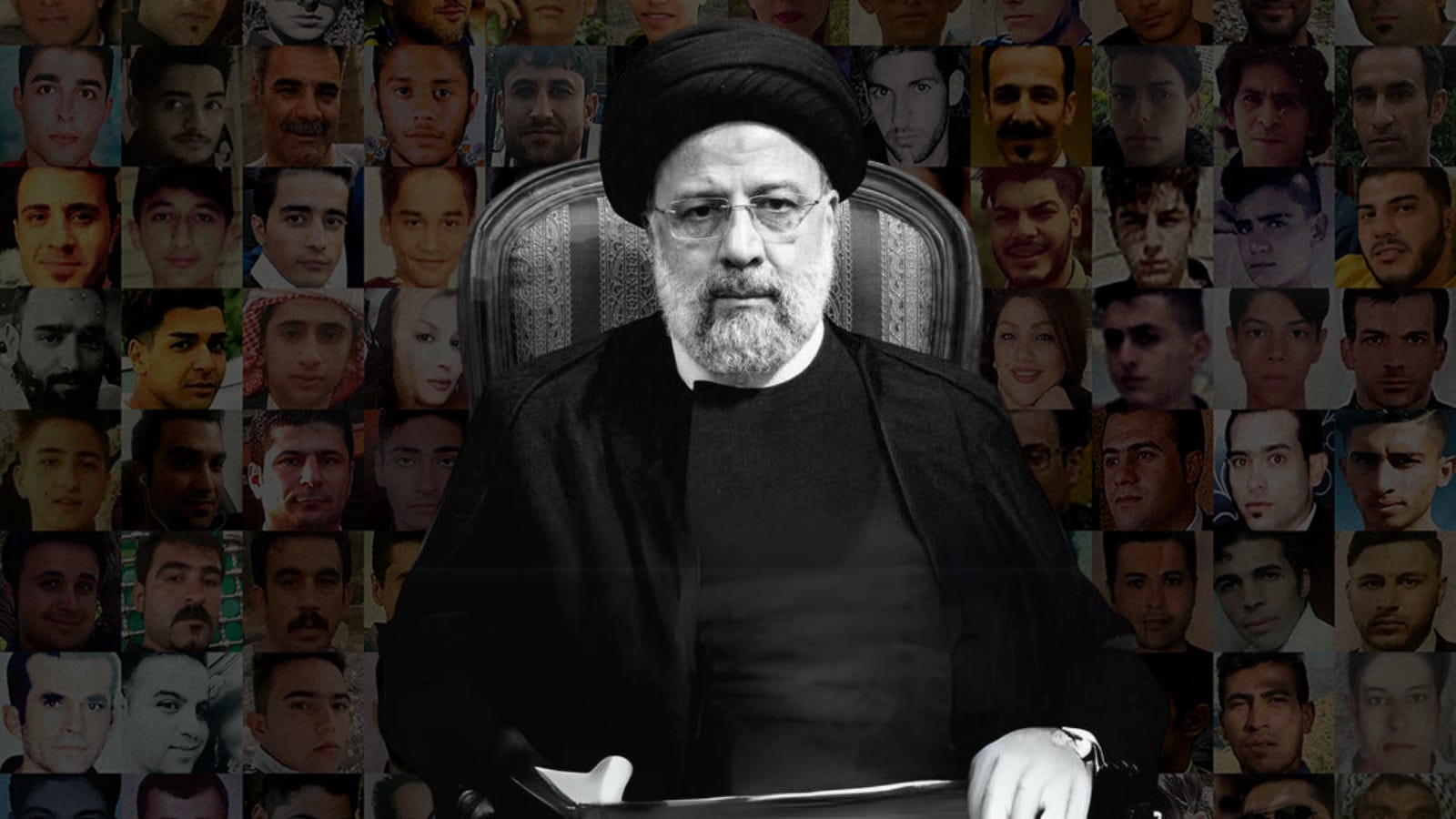
The Islamic Republic of Iran’s President Ebrahim Raisi died on Sunday, May 19, along with his foreign minister and other government officials, in a helicopter crash in a mountainous area in northwest Iran.
Instead of being investigated and prosecuted for crimes against humanity that he committed throughout his career, Raisi was declared president in June 2021 in a presidential election that was neither free nor fair, according to Amnesty.
Throughout his presidency, Raisi persisted in his brutal crackdown on political opposition and human rights—a direct result of systematic impunity in Iran.
“While a fatal helicopter ride means Iranians will not physically see Raisi in a defendant’s dock, his name will no doubt appear in future litigation as the architect and enforcer of policies that perpetrated the crimes against humanity of murder, rape, torture, and persecution,” said human rights lawyer Gissou Nia.
“The Butcher of Tehran”: Raisi’s Involvement in the 1988 Prison Massacres
Raisi had a long career in the government’s judiciary. In 1988, as the Deputy Prosecutor General of Tehran, he was appointed to a four-person committee known as the “Death Commission” by then-Supreme Leader Ruhollah Khomeini.
The “Death Commission” ordered the execution of thousands of political prisoners between late July and early September 1988. At least 4,500-5,000 political prisoners were summarily and extrajudicially executed after unfair, arbitrary trials that lasted just a few minutes. The victims’ bodies were buried in unmarked individual or mass graves, and many families were never informed.
For his role as a judge on the “death commission,” Riasi was nicknamed the “Butcher of Tehran.”
Iraj Mesdaghi, a survivor of the 1988 Prison Massacres now living in exile in Sweden, recalls Raisi visiting prisons to watch the executions.
Mesdaghi spent 10 days in the “death corridor” of Gohardasht prison and was released after promising to end all of his political activities.
“Whenever they went to execute a group of 10 or 12 or 15 prisoners, all the members of the Death Commission, including Raisi, went to the amphitheater and witnessed. And then they made a party. They came to our cells with cake and cookies and asked us to join their celebration,” said Mesdaghi.
Raisi's involvement in the crackdown on the 2009 protests
Raisi served as the First Deputy Head of the Judiciary from 2004 to 2014, playing a direct role in the crackdown on the 2009 nationwide protests following a disputed presidential election. He championed a campaign that included the arrest, torture, and execution of protesters.
He is associated particularly with the execution of two political prisoners, Arash Rahmanipour and Mohammad Reza Alizamani.
Head of the Judiciary during the 2019 Bloody November Protests
As Head of the Judiciary, Raisi oversaw a brutal crackdown on human rights during the 2019 “Bloody November” protests, initially sparked by a sudden fuel price increase.
From November 15 to 19, the government imposed a near-total internet shutdown and carried out one of the most brutal crackdowns against protesters. According to Reuters, around 1,500 people were killed.
Under Raisi’s leadership, the judiciary granted impunity to government officials and security forces responsible for the unlawful killing, mass arrest, enforced disappearance, and torture of hundreds of protesters.
During his two-year tenure as Head of the Judiciary, Raisi oversaw the execution of over 400 individuals, including political prisoners such as Navid Afkari, Mostafa Salehi, Ruhollah Zam, and Hedayat Abdollahpour.
The judiciary, collaborating closely with intelligence services, plays a key role in quelling dissent and prosecuting dissidents, such as students, street protesters, and activists.
“As the Head of the Judiciary since March 2019, Raisi was in charge of an institution responsible for many of the long-established patterns of rights violations in Iran, including the use of torture to obtain coerced confessions, prosecution of peaceful dissidents in grossly unfair trials, and lack of respect for due process rights,” said Human Rights Watch.
Brutal Crackdown on “Woman, Life, Freedom”
During Raisi’s presidency, his government brutally cracked down on the massive “Woman, Life, Freedom” anti-government protests, which erupted after 22-year-old Mahsa Jina Amini was killed in police custody in September 2022 following her arrest for allegedly wearing an “improper” hijab.
Security forces killed at least 551 protesters, including 68 children. Authorities detained more than 20,000 people, including journalists and celebrities. Several protesters were sentenced to death, and at least nine were executed after sham, unfair trials involving torture.
In March 2024, the UN Fact-Finding Mission on Iran determined that authorities committed crimes against humanity in the 2022-2023 anti-government protests.
Suppression of Women’s Rights
Raisi’s presidency is marked by a harsh crackdown on women’s rights and a commitment to upholding gender apartheid—a deeply institutionalized system of discrimination and oppression against women since the establishment of the Islamic Republic in 1979.
A few months before Amini’s killing, Raisi signed a decree in August 2022 enhancing punishments for women who violate mandatory veiling laws.
Raisi’s government also introduced and advanced the “Hijab and Chastity Bill” in Parliament, which is now in its final stages of becoming law. This bill intensifies punishments and surveillance for women defying mandatory Islamic dress codes and also targets business owners and employers who serve these women.