

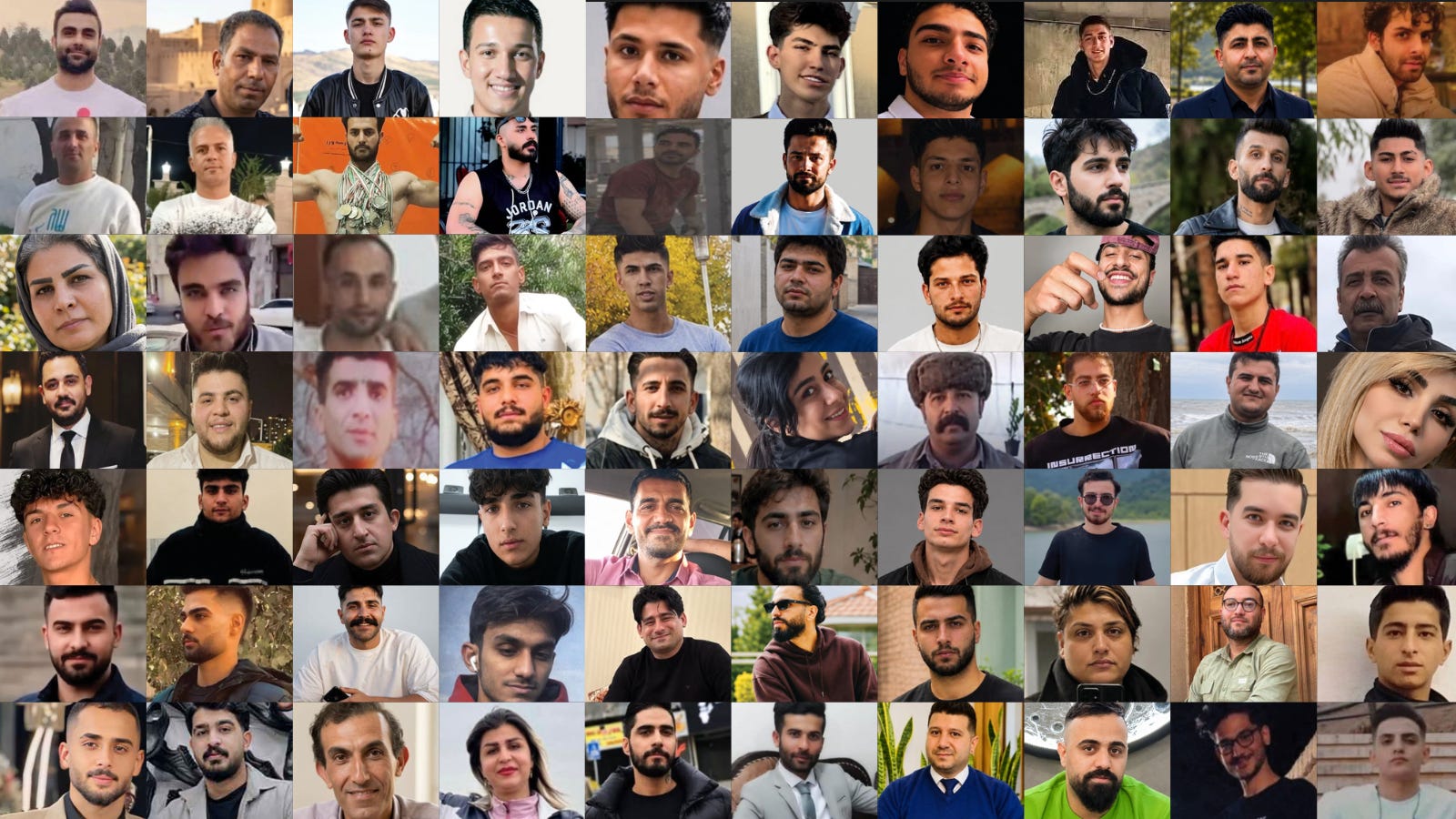
At least 121 protesters arrested in connection with Iran’s January 2026 nationwide demonstrations have been sentenced to death, a human rights organization said, warning that Iranian authorities could accelerate executions ahead of the first anniversary of the protests.
Iran Human Rights Organization said the documented cases include six women and at least five children and individuals who were under 18 at the time of their alleged offenses. The cases span 15 of Iran’s 31 provinces, suggesting the actual number of protesters facing execution could be considerably higher.
The actual number of protesters facing execution is likely far higher than what human rights groups are able to independently verify due to a lack of judicial transparency and intimidation of prisoners’ families and lawyers.
“Behind these death sentences are horrifying accounts of torture that are beyond comprehension,” said Mahmood Amiry-Moghaddam, director of Iran Human Rights. “Young protesters have been sentenced to death based on confessions extracted under torture, following grossly unfair trials by Revolutionary Courts. Even the few lawyers who dare to genuinely defend their clients face intimidation, persecution and serious personal risks.”
Since March 18, Iranian authorities have executed 41 protesters, including 39 arrested in connection with the January demonstrations and two associated with the 2022 “Woman, Life, Freedom” movement, according to the organization. During the same period, authorities executed 16 political prisoners affiliated with banned opposition groups and 17 people on alleged charges of espionage.
Iran Human Rights described the figures as the highest number of political prisoner executions within such a short period since the 1980s. Following the establishment of the Islamic Republic in 1979, the new authorities carried out summary executions of thousands of perceived opponents. In 1988, near the end of the eight-year Iran-Iraq war, Iranian authorities, acting on the orders of then-Supreme Leader Ayatollah Ruhollah Khomeini, executed up to 5,000 political prisoners.
Iran is one of the world’s leading executioners, second only to China. According to Amnesty International, at least 2,159 people were executed in Iran in 2025. Most executions in Iran are carried out for alleged offenses that are not punishable by death under international law.
In a joint statement delivered at the U.N. Human Rights Council on Sept. 30, 46 countries condemned the Islamic Republic’s escalating use of the death penalty and called on Iranian authorities to immediately halt executions.
Torture and forced confessions
Human rights organizations have documented cases in which protesters were sentenced to death following expedited trials marred by allegations of torture, coerced confessions, and serious violations of due process. Defendants in protest-related cases are systematically denied access to lawyers of their choosing, and courts frequently rely on confessions extracted under torture, often as the sole evidence for convictions.
According to Iran Human Rights, families of protesters facing execution have also been subjected to intimidation, threats, and arrests intended to prevent them from speaking publicly or to pressure detainees into making false confessions.
Iranian state media have broadcast forced confessions from hundreds of protesters, often before legal proceedings began, undermining the presumption of innocence and defendants’ right to a fair trial.
“The organization has reviewed multiple state propaganda videos portraying defendants making forced ‘confessions’, while they were forcibly disappeared and questioned without lawyers present. These were used as evidence to secure convictions,” Amnesty International said.
In many cases, Iranian authorities have used vaguely defined capital offenses, including “enmity against God” (moharebeh) and “corruption on earth” (efsad-e fel-arz), to prosecute protesters. Amnesty International has documented executions linked to alleged acts of arson, vandalism, obstruction of roads and public disorder, offenses that fall short of the international legal threshold for capital punishment.
Other protesters have faced prosecution under a sweeping espionage law that took effect in October 2025, following the 12-day war between Iran and Israel. Amnesty International said the legislation also criminalizes internationally protected activities, including peaceful demonstrations and providing information to foreign news outlets.
Lawyers targeted for defending protesters
Iranian authorities have routinely denied detained protesters access to independent legal counsel, instead assigning them government-approved lawyers. Rights groups have said these government-approved lawyers prioritize the state’s interests instead of adequately representing their clients.
“Defendants facing death penalty charges related to protests are left entirely defenseless during the most critical stages of their prosecution. Some state-approved lawyers routinely fail to challenge forced confessions, investigate claims of torture and ill-treatment, or present vital exculpatory evidence. Consequently, Revolutionary Courts swiftly issue death sentences based on uncontested evidence, and the Supreme Court simply affirms these verdicts without genuine legal scrutiny,” Iran Human Rights said.
Independent lawyers attempting to defend protesters have also faced persecution and intimidation, further restricting defendants’ access to independent legal representation. U.N. human rights experts have warned that courts have repeatedly obstructed independent lawyers from representing defendants in politically motivated proceedings, denying them access to their clients and case files.
Between September 2025 and September 2026, at least 135 Iranian lawyers faced judicial or security measures, according to U.N. experts. Among them were at least 23 lawyers arrested in January and February after the nationwide protests.
Human rights lawyer Amirsalar Davoudi was arrested on Oct. 11 after appearing before the Revolutionary Court in Isfahan to represent imprisoned protester Mahshad Keshani. Davoudi had also represented Keshani’s partner, Alireza Sepahi, who was executed on Oct. 5.
Davoudi had officiated the couple’s marriage while they were imprisoned and posted an audio recording of the ceremony on social media on October 4, a day before Sepahi was executed.
“Independent lawyers are increasingly being prosecuted and intimidated for their professional work and for defending human rights. This also harms their clients, leaving them increasingly vulnerable to arbitrary detention, coerced confessions, unfair trials and severe penalties,” a group of U.N. experts said in a Nov. 6 statement.
Fears of escalating executions ahead of protest anniversary
With less than two months remaining before the first anniversary of the January protests, human rights advocates fear Iranian authorities could intensify executions.
Amiry-Moghaddam criticized the international response, saying more than one protester has been executed each week on average since March without sufficient diplomatic consequences to deter Iranian authorities.
He called on European governments to adopt a unified position and warned that further executions must carry serious political and diplomatic consequences.
“An immediate moratorium on all executions must be a central demand in every dialogue with the Islamic Republic,” he said.