


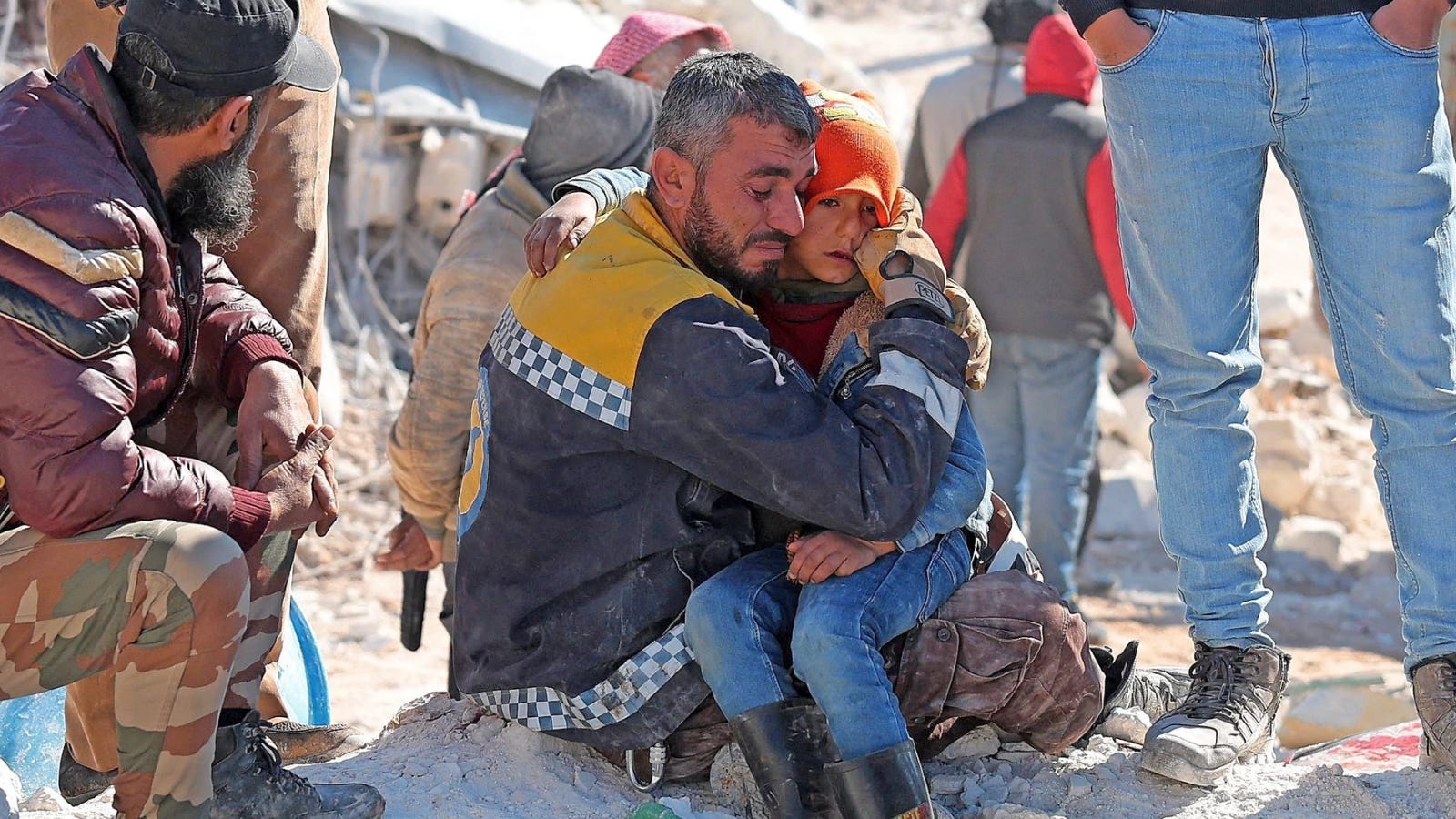
A magnitude 7.8 earthquake followed by multiple strong aftershocks struck Turkey and Syria in the early hours of Monday, February 6. Less than 12 hours later, a second 7.6 magnitude quake hit the same region, killing over 17,000 people and leaving thousands more injured. The death toll continues to increase by the minute. Hundreds remain trapped under buildings reduced to piles of rubble, with many calling for help from under the debris.
The quakes have devastated the impacted areas; however, for civilians in northwest Syria, it has doubled an already existing humanitarian crisis. Over 4 million civilians, 2.8 million of whom are internally displaced, live in the region’s opposition-held areas surrounded by the Assad regime and its ally Russia.
Over 90% of the population depends on the U.N. cross-border mechanism for life-saving aid; however, the earthquake has severely damaged the only remaining aid route, the Bab al-Hawa crossing.
Cross-border aid is a lifeline for millions in NW Syria
The UN cross-border aid mechanism was established in 2014 to offer a lifeline to millions of civilians in areas where the Syrian regime has purposely failed to provide humanitarian aid. It is an essential lifeline that ensures aid goes directly to the people without going through the Assad regime.
On Tuesday, the Spokesperson for the UN Secretary-General said in a press briefing that “the road that is leading to the crossing has been damaged, and that’s temporarily disrupted our ability to fully use it.”
On January 9, the UN Security Council voted to extend cross-border aid operations for an additional six months, saying “humanitarian needs have reached the highest levels since the start of the conflict in 2011, with people in Syria grappling with a harsh winter and a cholera outbreak.”
Russia vetoed a proposal that would have extended cross-border aid to Syria by one year. In the past, Russia, a vital ally of the Assad regime, has used its veto powers multiple times to reduce the number of cross-border aid routes from four to only one.
Now, with Bab al-Hawa damaged, no other authorized roads remain to assist with humanitarian aid deliveries for civilians struggling under harsh winter temperatures on top of the earthquake’s devastating impact.
The United Nations and the international community must act urgently and swiftly to open alternative routes into northwest Syria. Millions of people, including those currently trapped under piles of rubble, cannot wait for the official Bab al-Hawa route to become operational.
Other possible border crossings, such as Bab al-Salam, Jarablus, and Al-Rai, can be viable solutions to ensure that help is immediately extended to those most adversely affected by the earthquake.
Corpses cross the border but not aid!
“Every half hour or so, we see cars carrying the bodies of Syrian people who died in the earthquake in Turkey crossing the border into Syria. So how can the roads be closed for aid but open for funeral convoys?” Mazen Alloush, head of Bab al-Hawa border’s media relations, told Al Jazeera.
“We know that the UN aid is stored in the Turkish city of Reyhanli, which is just one kilometer away from the border crossing,” he added.
The White Helmets, a group of volunteer first responders, have been working around the clock to search and rescue victims buried under rubble. However, they are operating with limited resources and have not received any significant international or non-international assistance.
Six UN aid convoys that were scheduled to deliver aid before the earthquake entered northwest Syria from Turkey on Thursday morning.
“It is not special aid and equipment for the search and rescue teams and the recovery of those trapped under the rubble. We are disappointed at a time when we are desperate for equipment that will help us save lives from under the rubble,” the White Helmets rescue team said on Twitter.
This comes THREE DAYS after the devastating earthquakes, and yet it is not enough. The UN cited “logistical” reasons for halting aid delivery; however, trucks continued crossing the border not with aid but with bodies of Syrians killed by the earthquake in Turkey.
The Syrian regime and its allies are using this opportunity to demand the lift of sanctions, claiming that sanctions are the primary reason blocking aid distribution throughout the country.
"Assad government has no capacity to implement any aid operation"
“Cross-line aid [aid delivered from government-held areas into opposition-held areas] is not about how aid is routed into affected areas, but about who distributes the aid and controls the economy of the humanitarian operations in the north-west. The Assad government cannot implement any aid operation in north-west Syria,” Qutaiba Idlbi, Senior Fellow & Syria Lead at the Atlantic Council, told the Guardian.
Aid from several countries, including Russia, Qatar, Saudi Arabia, UAE, Tunisia, and Iran, has already reached Damascus but has yet to be allocated to non-regime areas in the northwest, where the earthquakes have hit the hardest.
Syria’s Ambassador to the UN, Bassam Sabbagh, told reporters on Feb. 6 that “any assistance must be done in coordination with the government and delivered from within Syria, not across the Turkish border.”
This is not anything new. It is a decade-long strategy by the Syrian regime to “co-opt humanitarian assistance and reconstruction funding to fund its atrocities, advance its interests, punish those perceived as opponents, and benefit those loyal to it,” as concluded by a Human Rights Watch report.
Time is running out for millions of people who are stuck between the Assad regime, Russia, and a dysfunctional UN strategy for aid delivery.
How to help northwest Syria:
Donate to these trusted humanitarian organizations providing emergency assistance to earthquake victims.
The White Helmets, also known as Syria Civil Defense, is a humanitarian volunteer organization that works around the clock for search & rescue aid.
The Molham Team is a non-profit organization that works on the ground with Syrian refugees & displaced persons.
The Syrian American Medical Society is a non-profit humanitarian organization that provides urgent medical care in Syria.
BAHAR is a local non-profit humanitarian organization delivering emergency aid to northern Syria.